Thursday, February 10, 2011
Luis Ferreira is the new team support

Looking for invertebrates
This year began with a lot of work. One of the activities that we realize is the identification of invertebrates. For it, we move up to the Biological Reserve where there are distributed 12 squared plots of 2x2 m2, in which there is placed a trap Pit-Fall in each one.
First, an inventory and identification in situ of the invertebrates for 1x1 m is realized which should be done in the same day. Secondly, the traps Pit-Fall are refilled by liquid Turkin, which allows the attraction and capture of invertebrate and preserving them. After 5 nights, his content is collected and will be analyzed.
This process should be realized every 3 months, on every station of the year, being the near sampling in the spring.
Alazne and SilviaTuesday, February 8, 2011
Great news from the Islet


Monday, February 7, 2011
The artificial nests of Cory's Shearwater are ready to be occupied
- To improve thermal conditions and prevent water infiltration inside the nest, we built a formwork cement casing around the hole, and a plywood lid lined with waterproof fabric was placed over it.
- To attract Cagarros by smell, we put feathers and droppings, collected last year from natural nests.
- Was also installed the sound system, with the vocalizations of this species.
Now Cagarros can come in!!!
Thursday, February 3, 2011
World Wetlands Day

On World Wetlands Day the project team collaborated on a field trip with the students of the Mouzinho da Silveira Basic Education School, organized by the Corvo Island Natural Park.
By 3 pm more than 40 students filled the fantastic view of the Caldeirão. Desiring to reach the foot of the majestic lake, they went down at high speed. We stop for a picnic lunch on the banks of the largest wetland in the island and then we took a walk around the East side of the lake.
In the evening a big climb awaited them. They reached the top with great effort, but their happy faces made us think that it had been worth the effort!
Thursday, January 27, 2011
Environmental Education
Hi Everyone!!
This week I am going to talk about the School activity, namely Recycling. So, this wenesday we receive the students of Corvo between ages of 6 to 16 years old. For the oldest ones we purpose a debate about what we produce?and what we should to do to transform these products? For the youngest ones we decided to recycle some old paper and ask to our "little people" to use that paper to draw Mr.Cookie from Shrek the animated movie. Besides this was my first experience with the kids, I think that the activity run well and allow the children to learn more about recycling.
T.Pippa.
Monday, January 24, 2011
One more...
Hi Everyone!!
I am the most recent resident of Corvo, the most isolated island of Europe. Besides the isolation the time goes faster than you should think, mostly because there are a lot of things to do. The true is that this island became my house and I really feel like it.
The work could not be better, basically I spent my time climbing the mountains, jumping walls, running from cows...this happened me the other day when me and my colleague Alazne were collecting wax-box in Fonte Velha, and some cow decided to attack us and the only thing that Alazne could say was " Don’t come around here….Don’t come around here.”.., to enjoy the fresh air and all of this with the Atlantic Ocean view.
By the way, I am going to stay in Corvo until December 2010 when my Cory`s Sherwater’s friends come to Corvo, but until that happens, I am going to look after the rodents, cats and Festuca plantations, some of the activities of the LIFE Project "Safe Island for Seabirds".
Thanks to all, since my colleagues Sandra, Carlos, Alazne and Sílvia, who patiently try to teach me something and to all people from Corvo, for being so nice to me.
T.Pippa.
Sunday, January 2, 2011
Happy new year 2011
We will start up again the field work in Corvo next week.
See you soon!
Friday, December 3, 2010
Science club: oil and paper recycling
Monday, November 29, 2010
Cory's shearwater S.O.S
At such hard time, hunger forced people to seek alternative food, for example, "Erva do Calhau" (an algae) and "Saramago" (an herb), because they could not cultivate the land during the winter due heavy storms.
The Cory's shearwater were also a food supplement for some people who were forced to learn some biological aspects of this species, such as hatching dates, that allowed to pick up eggs, and the period in which chicks had less fat and more meat. They also learned how to extract the oil from these birds to spread after their tools. Even serving as bait in the local fishery.
1 more ... equals 8
The Holly is an endemic species and its population is small and need some efforts to recover the species.
The fruits that was collected will be treated and sown in the greenhouse. Now it is 8, the species that we intend to produce.
At the time we are producing the following species:
- Morella faya
- Piconnia azorica
- Heather
- Azorean Cedar
- Azorina vidalii
- Frangula azorica
- Azorean blueberry
Hopefully we will have soon good news from the number of plants we are producing.
Here is one of the pictures Frangula azorica we seeded this year.
Thursday, November 25, 2010
Two British experts visit Corvo Island
Their mission is to analyze the feasibility of installing four hiking trails for the tourist who visit the island.
Wednesday, November 24, 2010
A birdwatching day
Telescope, 3 binoculars, bird guide and a backpack full of good mood is the material needed to spend a relaxed evening in Caldeirão, the ex libris of Corvo.
We took our visit to count birds for the National Waterfowl Wintering Program conducted by the 2nd consecutive year here on Corvo. By late morning our list was:
2 Grey Herons Ardea cinerea1 Common Snipe Gallinago gallinago
29 Mallard Anas platyrhynchos
40 Yellow Legged Gull Larus cachinnans
1 American Black Duck Anas rubripes
1 hybrid of Mallard x American Black Duck
Despite the rain and gray sky, was a morning well spent.
Monday, November 22, 2010
The Cory's shearwater activity: dataloggers
Friday, November 19, 2010
Biological reserves creation
Thursday, November 18, 2010
Science club in the school!

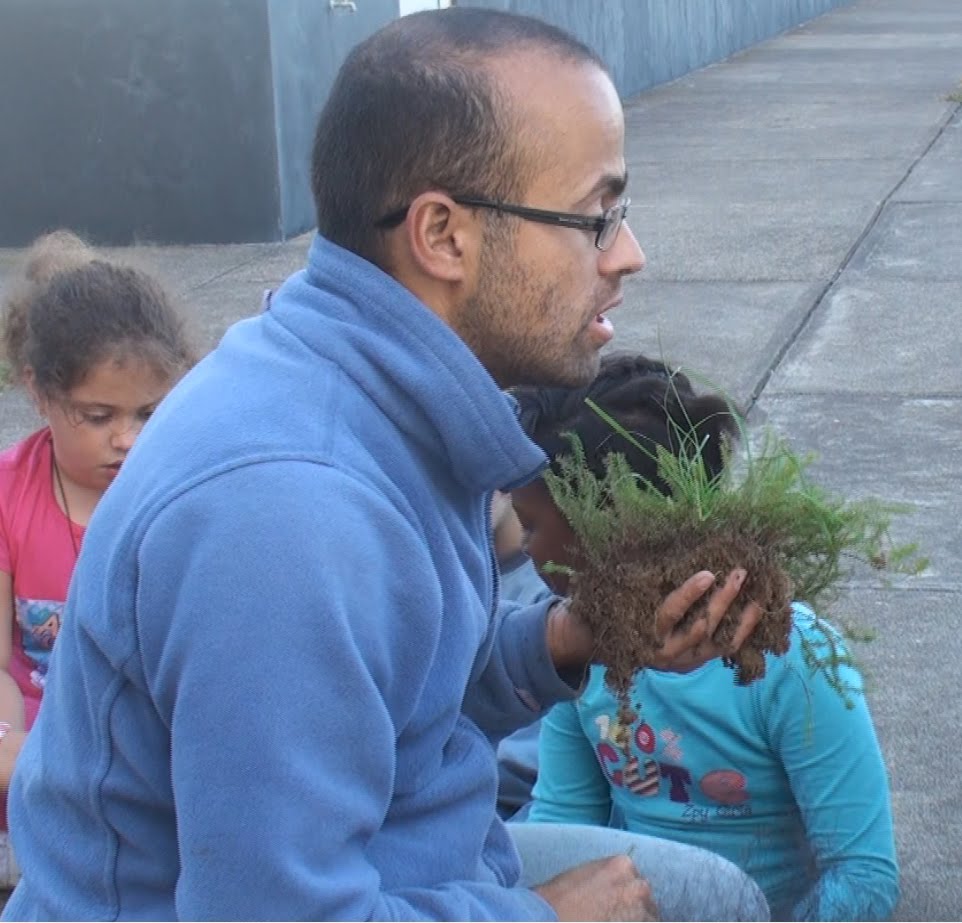
The project team is actively working with "Mouzinho da Silveira" School conducting activities in Ecology and nature areas. From previous school year, the students work with the Science Club and last week began with transplantation activities of one of the endemic plants: the Azorean Heather.

The children's club were divided into age groups and once again they showed their enthusiasm for this type of action.
Friday, November 5, 2010
Haunted House
It a was great fun and huge success!!
Thursday, November 4, 2010
Monitoring activities in Vila Franca islet
Corvo seen by its visitors
Read poem
Tuesday, November 2, 2010
Testing eradication of exotic rodents
Tuesday, October 26, 2010
Official Project Website has a new design
Also you can have a look or download from "Documents" all publicity materials and reports we have produced. The "Gallery" for images and movies will be available soon.
Keep following us.
Monday, October 25, 2010
The first Cory's shearwater chick leaves the nest!!

Last week we started to ring, to weight and to collect samples of Cory's shearwater chicks that are almost ready to leave the nests.
Most chicks are fully grown and almost fledging, and last Thursday night we rescued the first in Corvo Village, that was released at sea the next morning.
SOS Cagarro campaign is starting to have some busy periods and the volunteers should be ready in the next few days because the peak of the fledging season is about to occur, now that the chicks are getting ready to go to the sea.

Friday, October 22, 2010
Regional Government of Azores visited Corvo island
Thursday, October 21, 2010
Cory's shearwater breeding success
Monday, October 18, 2010
Corvo receives lots of visitors...
Last week the Scientific comission visited Corvo Islands and evaluated the project actions. During the meeting it was discussed in what way the methods used can be improved and how we should proceed to the data treatment.
The visits were very profitable and resulted in various valuable sugestions and ideas to improve the project actions. We managed to visit all the project intervention areas, although the winter days are coming. In between rain and strong winds we were lucky enough to catch some sunny moments to visit the altitude reserve and show the "Caldeirão" to the Comission.
Beside the project team, the meeting counted with the presence of Jaime Ramos (University of Coimbra), Manuel Nogales (CSIC), Steffen Oppel (RSPB), Raquel Ferreira (SRAM) and Joaquim Teodósio (SPEA).
Wednesday, October 13, 2010
Abundance estimate of rodents on Cory's shearwater colonies
Thursday, October 7, 2010
Wild cats detection with surveillance cameras
Every two weeks a technician visits the colonies to check and move each camera to a new capture point.
Wednesday, October 6, 2010
Cat census in Corvo island
This summer, with the cooperation of the Corvo inhabitants, we made a campaign consisted on the neutering of all the domestic cats inthe village and to tag them with a small identification microchip.
This campaign is necessary to prevent the increase of the feral cat population in the near future.
Tuesday, October 5, 2010
First seabirds sound recordings in the project!!
We will change the recorder to a cliff on the east side, where in the night census were recorded Petrels, between July and August.
We will continue to give more news about this issue!!
Friday, October 1, 2010
European Commission visits our project!
Last week, three representatives of the European Commission came to Corvo to check the progress and the work done on all the areas on the scope of the LIFE project.
The visit went smoothly and the commission was pleases with the progress of the actions.
Several people attended this formal visit and related meetings, nominately the SPEA team and representatives from all the partner institutions: Frederico Cardigos (Regional Director of Environment), Jorge Cardoso (Island Nature Park Director), Manuel Rita (Mayor of Corvo), Luis Costa (SPEA Executive Director), Iván Ramírez (European Marine Program Coordinator), José Pedro Tavares (RSPB), Pedro Luis Geraldes, Sandra Hervias, Nuno Oliveira and Carlos Silva (project team).
Last night the third project public meeting took place in the Santa Casa da Misericórdia opened to the general public. The session was opened by the Regional Director of Environment and the Executive Director of SPEA, and was we had the nice surprise to see that we had an audience of around 80 persons.
Thursday, September 30, 2010
My first day as biologist!!
Wednesday, September 29, 2010
The peddy paper was a great success!!
Children and technicians enjoyed the activities in each point, such as: using GPS to recover wax blocks used to track rodents, identification of endemic, native and exotic plants that are growing on Corvo, and visit a Cory's shearwater colony, among other things...
This week we will post a little video with such activities.
Don't miss it!!!
Tuesday, September 28, 2010
We found the first Manx shearwater (Puffinus puffinus)

Two weeks ago, we found the first Manx in "Vila do Corvo". In the morning, we ringed and weighed it, measured the length of the wing and collected a blood sample for genetic study. Later, we released it in the Biological Reserve of Corvo, into a Manx artificial nest to meet a new potential area for nesting. After a few minutes the bird left the nest and took his way to sea.

Friday, September 3, 2010
Finally, we found Azorean Blueberry!!!

Today, Julia, the volunteer of the project went to Corvo Crater to seek for the Azorean Blueberry.
The Azorean Blueberry is an endemic plant almost extinct in Corvo. Many other plants that aren't from the island, such as Hortensia (very present throughout the archipelago), are decreasing the area of distribution of endemic species that needs especific characteristics to growth.

It was surprise!! Inside small streams we found several plants. Many of them with mature fruits and many others almost mature, which will be caught in mid September.
Collecting the fruit of this plant, characteristic for it's sweet and a dark Blueberry, will be a great help to increase the diversity in the biological reserve of the project. In this reserve will be planted Azorean Blueberry, Heather, Azorean Ceader, the Hollytree and Buckthorn bush.Thursday, July 29, 2010
Ear tags for wild cats
We have selected an international system for tagging feral cats, ear section of the apical part of the left pinna. This cartilage area is very little irrigated and does not suffer bleeding and, therefore, very difficult to infection.
In the photo you can see a female sterilized last week sunbathing on a rooftop in the village of Corvo.
Wednesday, July 28, 2010
Olá,
We are Jannes and Jakob and decided to use our free time between our biologic studies to help in the SPEA project on Corvo Island. Me, Jannes, I am 23 years and currently studying Biologie in Kiel, Germany. And me Jakob, I am 21 years old and going to start studying Biologie in Bremen, Germany.
After school we both volunteered in the Wadden Sea of Schleswig-Holstein, Germany, became best friends and developed same interest like Marine Biologie as well as bird watching.
We arrived on Corvo on friday 23rd of july and are going to stay for almost two months.
Our main task in the project will be focused on nest-investigation of Cory´s Shearwater and we will give a hand in any situation where it could be useful.
We already took all the kind people and of course the funny sounding Cagarros to our heart and we are looking forward to some wonderful weeks in the middle of the Atlantic Ocean.
Saturday, July 10, 2010
"Biologia no Verão" - Discover the activities on Corvo island at this Summer!
On 10 and August 24, and September 7 will be held the activity "Discovering the Azores laurel." Participants will have the opportunity to meet the remaining natural flora on Corvo, while they learn with simple gestures can help in their conservation.
During the mornings of 20-22 August, participants can see up close, and feel in their hands, small birds that come every day or hear from far, in parks and gardens. The activity will take place is "Discovering Birds around us" which aims to feature some aspects of conservation and take interested parties to participate in a technique long used by experts worldwide for the study of birds - capture using miss-nets.
Friday, July 9, 2010
Trying to get further help!
The processing can be done from your home and you just need an internet connection and the Microsoft Excel program. Below is an example of one of the cat pictures recorded last week.
If you are interested, get in touch to receive more information.
Just comment on this post or send an email to nuno.oliveira@spea.pt.
Cheers!
Tuesday, July 6, 2010
The Spotlight

We were able to find five cats during the survey with the spotlight; one of wich was eating the remains of a dead Cory's found dead next to the road.
.
Friday, July 2, 2010
Cagarros colony (Calonectris diomedea) - João de Moura pinnacle. Corvo island
Thursday, July 1, 2010
Tuesday, June 29, 2010
Cory's shearwater peaked at posture a few days ago!
The same six Cory's shearwater colonies monitored last year by Ana Henriques, whose results are ready to be discussed on her Master thesis, began to be visited this year after Cory´s arrival in mid-March. 99% of the occupied nests last year were also occupied this year.
In Corvo, peak egg laying occurred on June 11 while last year
It seems that some couples have trouble finding a hole to nest as you can see from the picture.
A few days after the peak of egg, some depredations have been detected.
We will keep the blog up-to-date on the current breeding season of Corvo Cory's!
A sound recorder arrives at the project!!

At the end of last week, we put on a cliff an automatic sound recorder for the birds in the Corvo island. The recorder was placed on the cliff near the Pingas area, which tends to listen Estapagados frequently.

This method can show what kind of seabirds use that area, and by comparison with the vocal activity recorded in other more accesible colonies, it can help to determine the size of the colonies in Corvo. If this method gives satisfactory results, in the future can be used recorders like this for the detection and quantification of the seabirds colonies.
Radar continued...

These are images that me and Pedro, the project coordinator, saw in the monitors. They collected the amount of cagarros who were in the areas covered by the radar. The yellow dots mark the number of birds, and the blue dots the speed of flying.The radar was placed at different locations into the island. On land we choose points on the cliffs, to capture better the nocturnal movement entering and leaving the nests, to understand the possible differences in habits. Finally, we put the radar on a boat sailing around the island, and we get better and more accurate measurement of cagarros residing in Corvo island.
The result was an entire success, the radar technicians and Pedro Geraldes were satisfied with the hard work at night.
The location of birds, plus the complexity of them, brings to
these events a very important step. We must consider that it is the first time that is performed this type of seabirds monitoring in Portugal.Friday, June 4, 2010
Seabirds detected with radar!
This week a group of specialists is in Corvo island to test innovative techniques to detect seabirds using radar systems.
The study of seabirds has many technical difficulties to researchers, which are often difficult to overcome. Its nocturnal behaviour, together with the breeding habit of building their nests in burrows in the ground, often in inaccessible cliffs, makes it impossible to determine the size of some populations.
SPEA teamed up with Portuguese and foreign experts, to use radar detection techniques to study these birds for the first time in Portugal. The detection and study of birds using radar had been used for monitoring of wind farms and in studies of the New Lisbon Airport, although the detection of flying seabirds, due to their habits and places of occurrence, present other challenges and increased difficulties for their study. "For the first time we may know how many birds use the cliffs, which areas they prefer and whether it is possible to ID different species at long distances and without actually seeing the birds." says Pedro Geraldes, the project manager.
The results will determine the future operations of the project and might be an important milestone that opens new doors to the study of such birds in the archipelago."If we get good results with the use of radar, new possibilities for the study of seabirds in the Azores and elsewhere in the Atlantic will open up and will allow us to know details of the life of these birds that until now were impossible to determine" affirms Pedro Geraldes.